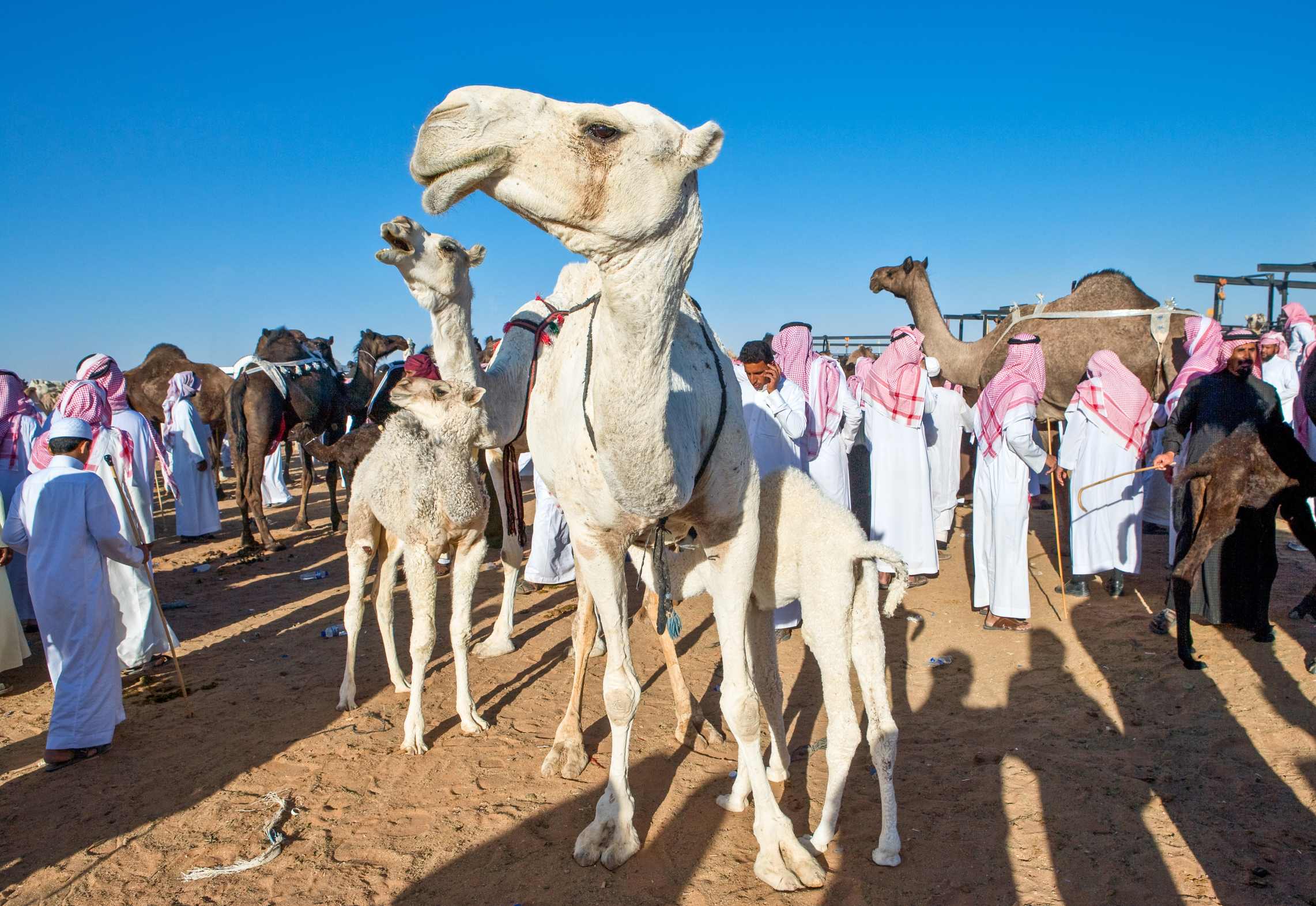
The camel beauty contest in Saudi Arabia is drawing global attention as participation from across the Gulf continues to rise—boosting tourism revenues and supporting the Kingdom’s broader economic vision.
The stage is vast, the atmosphere electric, and nearly 30,000 “models” line up to compete. Held in Rimah, a governorate near the Saudi capital Riyadh, the contestants arrive from across the GCC, including Kuwait, Qatar, and the U.A.E. While the setting may seem unconventional, it makes perfect sense when the models are camels.
The scene is part of the King Abdulaziz Camels Festival, a large-scale heritage event dedicated entirely to camels and Bedouin culture. Often dubbed “Miss Camels” internationally, or formally known as the King Abdulaziz Camels Competition, the beauty pageant is the festival’s centrepiece and has grown dramatically since its inception.
From Bedouin tradition to national spectacle
The event traces its origins back to 1999, when a small group of local Bedouins organized a competition to crown the most beautiful camel. Known affectionately as the “Ship of the Desert,” camels were once essential to Bedouin life—serving as transportation, sustenance, and economic assets in the harsh desert environment.
What began as a grassroots initiative quickly gained royal patronage and public interest. Over time, it evolved into a major heritage festival, attracting camel owners and visitors from across the Gulf. According to organizers, the 2017 edition welcomed around 10,000 visitors, a rise attributed in part to a fast-track visa counter introduced specifically for festival attendees.
The festival has since become aligned with Saudi Arabia’s Vision 2030, contributing to economic diversification while promoting cultural tourism. It is also widely regarded as a key platform for preserving and transmitting Islamic and Bedouin heritage to younger generations who have not experienced traditional desert life firsthand.
A living connection to Bedouin heritage
“Today there is very little Bedouin life remaining, but the attachment to camels remains strong on several levels—personal ownership, economic value, and sport,” says Dr. Talal Al Torifi, a historian specializing in Bedouin practices and a close advisor to the festival.
“In the past, camels were central to Bedouin life—as transport, food, loyal companions, sturdy workers, even a source of shelter, milk, leather, and meat. The festival reflects every aspect of the relationship between people and camels, both historically and in the present day.”
Support from the Saudi royal family has significantly expanded the festival’s scale. “Thanks to royal backing, the festival now spans 30 square kilometres of the ad-Dhna desert,” Al Torifi explains. “We are proud to showcase interactive experiences that reflect what is important to our region—combining traditional practices with new concepts that educate and engage everyone, from children and families to international tourists.”
Held from March 19 to April 15, the festival extends far beyond the beauty competition. Visitors experience a bustling heritage market, camel-owner tents, elaborate lighting and décor, and a growing list of entertainment activations. Highlights include a traditional souk, a planetarium illustrating the role of astronomy in desert navigation, camel auctions, camel-riding camps, and a dedicated children’s festival designed to instill pride in Bedouin heritage.
Miss Camels: the main attraction
Despite its many offerings, the camel beauty competition remains the festival’s biggest draw. In 2017, approximately 30,000 camels competed for a total prize pool of $31 million, distributed across 270 awards—making it one of the richest competitions of its kind.
Camels are judged by a panel of Bedouin experts based on age, breed, and grouping, with a strict emphasis on natural, untouched beauty.
“Judges look for purity and natural features,” says Al Torifi. “Camels are assessed by breed and colour, whether competing individually or in groups. Winning camels can fetch millions and often cause a spike in camel prices across the market.”
From the white Wadah camels to the dark Al Majahateer and the reddish-brown Al Homor, each breed is judged on specific aesthetic criteria. These include the size and shape of the head, whether the lips cover the teeth, neck length, hump height and roundness, eye size, eyelash length, nose droop, ear position, and overall symmetry.
Around 80% of participating camels came from Saudi Arabia, with the remaining 20% arriving from other GCC countries.
A festival reborn
The 2017 edition also marked a major rebrand. “The festival has grown significantly—not just in scale and entertainment, but in prize money,” Al Torifi notes. “More than $30 million was allocated to camel beauty awards alone, making it the largest prize pool ever for such a competition.”
The event was officially renamed from Mazayen Al-Ibl to the King Abdulaziz Camels Festival, reflecting its expansion under royal patronage. With improved organization, new judging criteria, and expanded family-friendly activities, the festival now offers greater opportunities for camel owners and broader appeal for visitors.
As the desert’s prized beauties retreat to prepare for next year, the festival leaves behind more than memories. It reinforces cultural identity, revives Bedouin traditions, and cements Saudi Arabia’s ambition to blend heritage with tourism and economic growth—one camel at a time.