This story appeared in our December 2025–January 2026 combined issue.
Dubai’s property market is moving through a defining moment. Prime residential prices are among the fastest rising globally, institutional capital is flowing into the Gulf, and governments are accelerating long-term development programmes. At the center of this momentum sits Sobha Group.
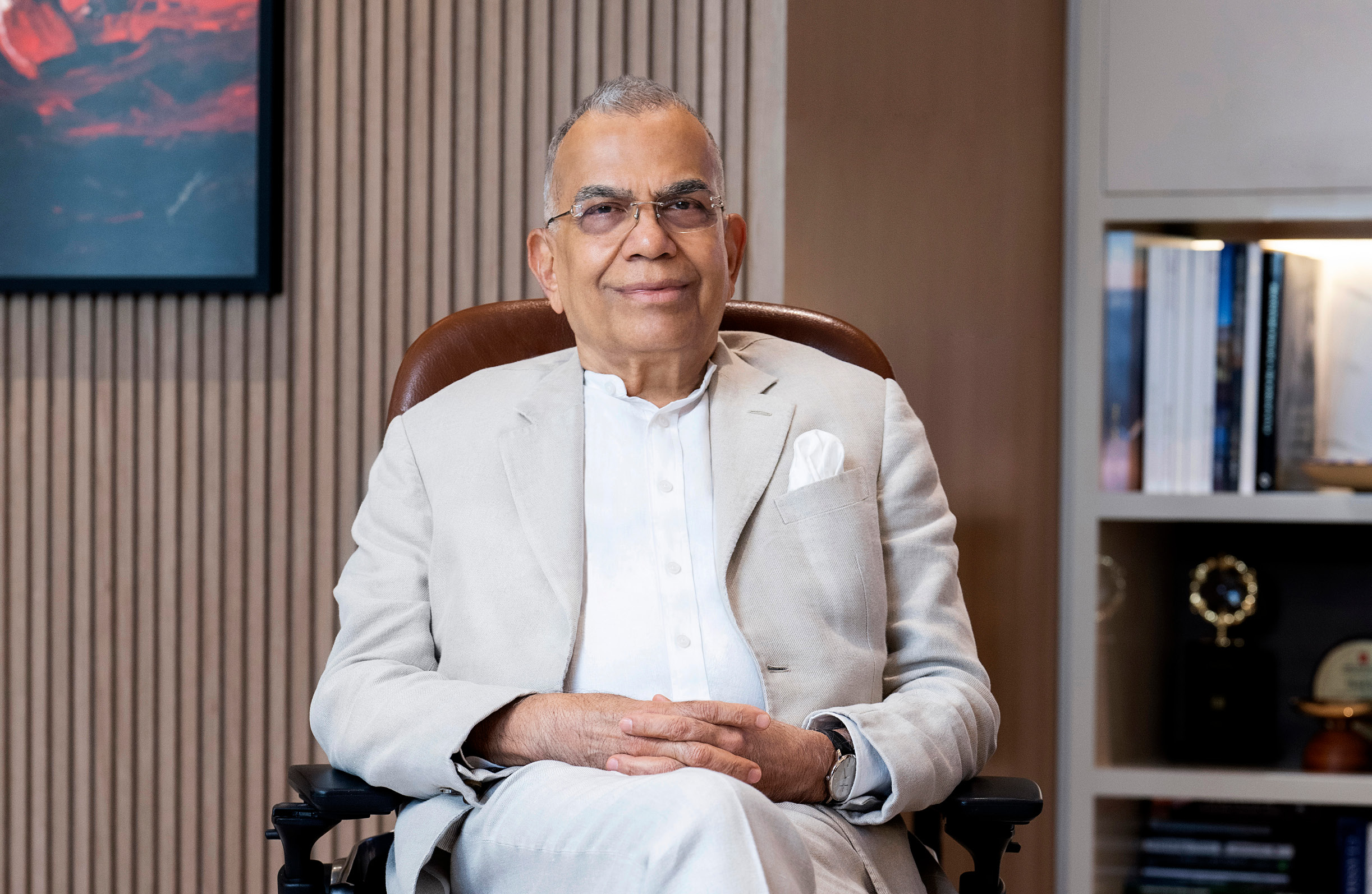
The company closed 2024 with record sales, is targeting an $8 billion outlook for 2025, and continues to build one of the region’s largest fully integrated furniture and interiors ecosystems. For its founder, 77-year-old PNC Menon—an Omani citizen, Indian-origin entrepreneur, and self-made billionaire with an estimated net worth of $3.6 billion as of December 2025—this moment is not one of consolidation. It is a transition.
“In 2025, we expanded into two U.A.E. markets—Umm Al Quwain and Abu Dhabi—and we should reach around $8 billion in overall sales,” Menon says. “But the real work today is done by my son, Ravi, as Chairman, and our Managing Director, Francis Alfred. They are the heads now, not me.”
The line is characteristically direct, delivered at a time when Sobha is outperforming a competitive market and broadening its operational base.
Sobha’s growth in the Middle East rests on a strategy many dismissed when Menon first pursued it: backward integration at scale. In practice, this means owning and controlling large parts of the supply chain—from design and engineering to interiors, joinery, stonework, metal fabrication, and increasingly, automated manufacturing.
“Back then, nobody believed in it,” he recalls. “They said, give the work to contractors and suppliers. But if you give everything to others, you can’t build the product you dream of.”
The strategy has become one of the Group’s defining advantages. Sobha Realty recorded 50% year-on-year sales growth in 2024, closing with $6.3 billion. Its first island project in Umm Al Quwain—Sobha Siniya Island—generated $1.36 billion in sales within five months of launch, accounting for 21.7% of annual revenue. Other notable developments include Sobha Elwood, Sobha Orbis, and Sobha Solis.
That momentum carried into 2025. The company achieved $4.2 billion in sales in the first half of the year, a 73% year-on-year increase, while revenues surged 83% to nearly $2 billion. To date, the Group has delivered more than 120 million square feet of residential, contractual, and commercial projects.
In September 2025, Sobha Realty issued its inaugural $750 million Green Sukuk, oversubscribed 2.8 times. The transaction—the largest in the company’s history and the largest Green Sukuk issued by any global real estate developer—will be listed on the London Stock Exchange and Nasdaq Dubai. For an organisation known for engineering-driven discipline, the deal marked Sobha’s arrival at the center of regional capital markets.
Menon built the framework for that discipline over decades. Sobha operates a 700-person architectural and engineering studio in Dubai dedicated solely to the Group’s projects. Its industrial footprint across the U.A.E. continues to expand, with a 53,000-square-metre automated furniture factory coming online in Dubai Industrial City.
The Group has also launched The Gallery, a B2B concept space on Sheikh Zayed Road where architects, interior designers, and developers can test ideas, materials, and concepts alongside Sobha’s teams. Illuminated box mock-ups, modular zones, material libraries, and technical rooms allow projects to be co-created from concept to execution. The Gallery is not a showroom; it is a professional workspace built for collaboration, signalling Sobha’s ambition to deepen its design-led credentials.
Menon sees this expansion as essential to future-proofing Sobha’s margins, product consistency, and brand identity. Controlling every nut, bolt, material, and line of design in-house is what first drew global academic attention.
“When Harvard University came to study us, they wanted to understand why others hadn’t implemented backward integration,” he says. “I told them, I don’t know why they didn’t. I only know we did—and it worked.”
For Daniel Hadi, CEO of Engel & Völkers Middle East, developers bringing more production and design in-house is reshaping expectations across the luxury market. “When developers control the process from design through construction, they gain full quality oversight and deliver a far more consistent final product,” he says. “It preserves project identity and results in a more refined and reliable luxury experience, which is quickly becoming the benchmark in the Middle East.”
Backward integration also enables Sobha’s next leap: robotics and AI-driven construction. Menon says the transition has already begun. “In five years, blockwork, plastering, painting, tiling, reinforcement—robots will do it. That is inevitable. And I cannot lead that change. My son and Francis must.”
His candor on succession is striking, particularly for one of India’s 100 richest individuals, according to Forbes. Yet it is consistent with his approach—grounding ambition in realism.
That realism was forged early. Menon left Kerala in 1976 with $7.50 and moved to Oman, where he started an interior decorating firm, STC. By 1995, his company was working for royalty across Oman, Bahrain, Brunei, Qatar, and Tajikistan. Seeing opportunity in India’s emerging property market, he founded Sobha Developers—named after his wife—in Bangalore in 1995, before expanding into Dubai in 2003.
The Middle Eastern business evolved into Sobha Realty, with operations across the U.A.E., Qatar, Oman, and the wider Gulf. This is not a rags-to-riches tale, but one of compounding skill and disciplined reinvestment.
Menon’s son Ravi, an engineer educated at Purdue University in the U.S., took over as Chairman in 2024. Menon remains closely engaged. “From 12:30pm until 7:00pm, I work with a group of young engineers and managers,” he says. “Many of them are better than me in their fields—which is how it should be.”
Asked what advice he offers entrepreneurs, he replies without hesitation: “The most dangerous thing in business is advice from people who don’t know your domain. Be honest, be fair, be responsible, and master your field. Any shortcut will shut you down.”
His own mastery came from necessity. “I had no money, so I learned every nut and bolt,” he recalls. It is the same principle that guided how he brought his son into the business—by exposing him to the craft, scale, and responsibility behind it.
That responsibility extends far beyond commercial success. Menon is among the region’s most active philanthropists, having pledged 50% of his wealth to charitable causes. He and his wife are signatories of The Giving Pledge, launched by Bill and Melinda Gates alongside Warren Buffett in 2010.
“I decided 40 years ago that half of whatever I make will go to philanthropy,” he says. “This year, from $1.14 billion in profit, $570 million goes to charitable work. This is fixed.”
His initiatives span housing, healthcare, education, cultural preservation, and women’s empowerment across India, Oman, and the U.A.E. In Dubai, he serves on the board of the Rashid Centre for People of Determination and has pledged $108.9 million with Mohammed bin Rashid Al Maktoum Global Initiatives to establish an endowment supporting the Arab Reading Challenge.
He has donated $13.6 million to the 1 Billion Meals Endowment, helped raise $60 million for a cancer hospital with Al Jalila Foundation, contributed $1.36 million to the BAPS Hindu Mandir in Abu Dhabi, and committed $24.9 million to housing projects in Oman. Through the Sobha Foundation and Sri Kurumba Trust, he supports housing, senior care, vocational training, and community development across Kerala.
In 2025, Sobha granted employees a special $40.8 million bonus—a gesture Menon describes simply as “charity beginning at home.”
Despite stepping back, his imprint remains visible across Sobha’s momentum. The Group’s expansion into Umm Al Quwain includes Downtown UAQ | Sobha Realty, a 25 million-square-foot master development planned to house more than 150,000 residents. Its furniture factory network, totaling 73,000 square metres, positions Sobha as one of the region’s most advanced interiors producers.
“High-end buyers are prioritising quality and clear differentiation,” Hadi notes. “Developers are responding with stronger master planning, lifestyle and wellness amenities, and sharper execution.”
The clearest link between Menon’s past and Sobha’s future is the manufacturing mindset he instilled from the beginning. “If you ask me to start again, I will go back to the same road,” he reflects. “I enjoy every bit of this industry.”
That road now stretches into new technologies, new emirates, and new sectors—from AI-assisted construction to large-scale manufacturing. The founder who once arrived in Oman with $7.50 now oversees a group spanning real estate, design, engineering, industrial production, and philanthropy across the region.
The next chapter belongs to the generation he prepared. But its foundation is unmistakably his.
“I may not be relevant for the next advancement,” Menon says, “but I can have people who are. That is my job now.”