The move followed a 2017 dispute that resulted in Saudi Arabia, the United Arab Emirates, Bahrain, and Egypt imposing a blockade on the small but energy-rich state of Qatar. While the blockade, combined with the COVID-19 pandemic, pushed Qatar toward greater economic self-reliance, the reopening of borders brought renewed optimism. For residents of the region, it meant restored communication and access. For Qatar, it allowed the country to move forward confidently with its preparations to host the FIFA World Cup 2022 and begin its post-pandemic recovery alongside its powerful neighbors.
For Qatar’s richest businessman, Sheikh Faisal bin Qassim Al Thani, the reconciliation represented a natural and inevitable step forward. “The previous challenges that we faced are history now,” he says. “They are gone, and we should talk honestly without exaggerating or underestimating things. The crisis, whether in our country or another, is fate and destiny.”
At 73, the quietly spoken but energetic chairman of Al Faisal Holding has reason to look ahead with optimism. His group is Qatar’s largest private hotel owner, with a portfolio of 34 luxury hotels comprising approximately 6,600 rooms. With geopolitical tensions easing and global travel rebounding, Qatar was expected to welcome up to 1.7 million visitors during the World Cup, according to aviation estimates. For a country with a population of just over 2.8 million, the influx represented a major boost to the hospitality and tourism sectors.
Al Thani’s hospitality empire spans four continents. His international portfolio includes the St. Regis in Washington, D.C., St. Regis Bal Harbour, W Miami, JW Marriott Istanbul Bosphorus, Four Seasons at First Residence Cairo, and the M Hotel in Makkah, located minutes from the Haram, Islam’s holiest site. The group also owns hotels in Italy, Germany, the United States, the United Kingdom, Egypt, Algeria, and Turkey.
Despite this extensive hospitality footprint, Al Thani’s largest investment is in Aamal Company, a publicly listed Qatari conglomerate focused on industrial manufacturing. Founded by Al Thani, Aamal produces cement, steel, pipes, and cables, and he continues to hold a 70 percent stake. Al Faisal Holding also has interests in real estate, jewelry, trading, education, and industrial ventures. Its education portfolio includes the Gulf English School and Stenden University Qatar, alongside an equestrian training center and a sports academy.
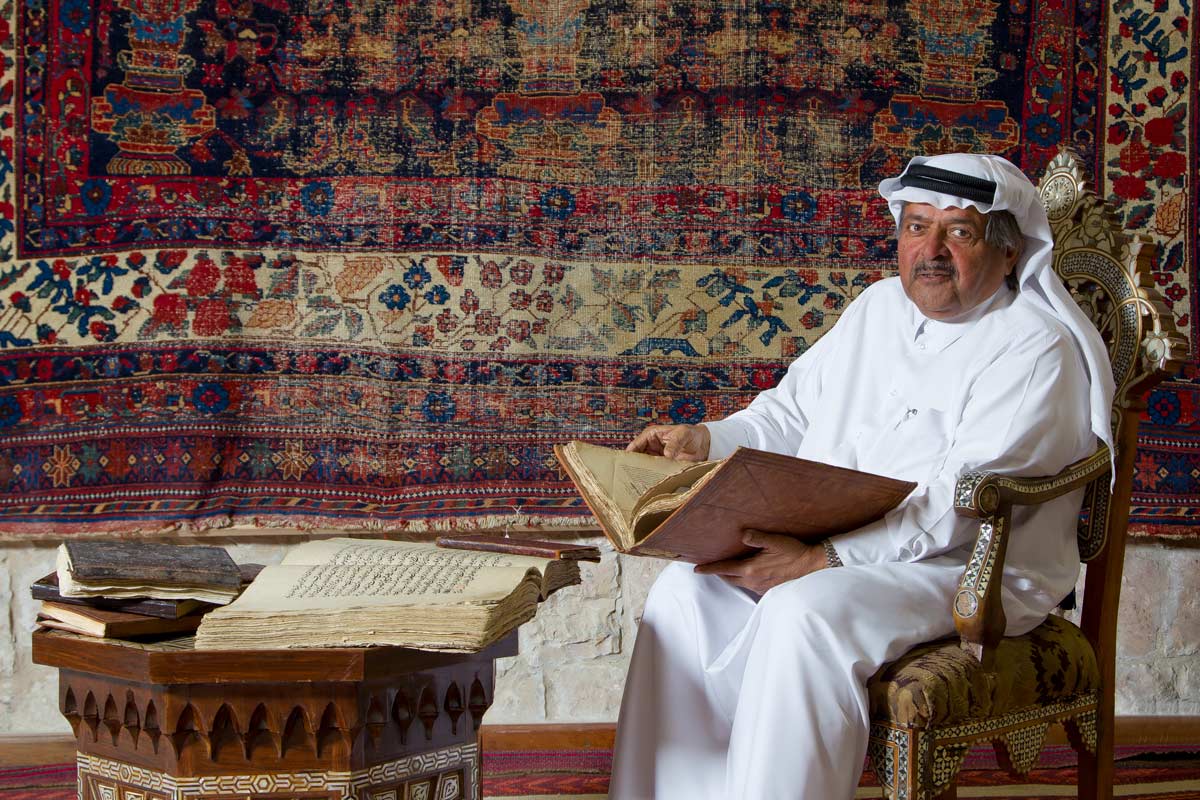
Today, however, Al Thani’s greatest passion lies in art and culture. He is the founder of the Sheikh Faisal bin Qassim Al Thani Museum, one of the world’s largest private collections of historical artifacts. Established in 1998 in the village of Al Samriya, the museum houses more than 30,000 items ranging from the Jurassic period through the early Islamic era to modern times.
“I have collected around 99 percent of the pieces in the museum,” he says. “I have rare books, manuscripts, and calligraphy from the great masters.” Among the museum’s highlights are a Quran room containing a Kiswah, the ceremonial cloth covering the Kaaba in Makkah, a reconstructed Damascene house from Syria, and a collection of more than 600 vintage cars.
“His passion for collecting historical artifacts has always aligned with his vision of building a cultural legacy for Qatar and beyond,” says Claudio Cravero, director of the museum. “It is an honor to be the custodian of such a unique institution.”
In 2013, Al Thani expanded his cultural footprint with the opening of the Sheikh Faisal Oriental Carpet Museum in Doha’s West Bay district. The museum showcases more than 500 rare carpets from Iran, Turkey, India, and Egypt, dating from the 17th to the 20th century. “Masterpieces have no nationality,” Al Thani notes. “That is why preserving them matters.”
His commitment to cultural dialogue also led to the creation of The Majlis: Cultures in Dialogue, an exhibition launched in France in 2018 in collaboration with Qatar Museums and UNESCO. The exhibition toured several European cities, including Paris, Vienna, Malta, and Madrid, and is expected to resume internationally.
Al Thani’s entrepreneurial journey began early. At just 16, he launched his first business trading car parts in Doha in 1964, when Qatar’s population was fewer than 50,000. “The market was small and competition was tough,” he recalls. His initial goal was simply to cover employee salaries, but growth followed quickly.
By 1966, he had opened a branch in Lebanon. In 1969, he secured the exclusive Bridgestone tire dealership in Qatar and established Gettco Construction, which later built many of his hotels and real estate projects. He founded the Ebn Sina Medical chain in 1971 and spent the following decades diversifying into education, manufacturing, transport, retail, and hospitality.
A major milestone came in 2001 with the establishment of Aamal Company, followed by the creation of Al Rayyan Tourism Investment Company in 2003. The hospitality arm expanded internationally with major acquisitions in Berlin and New York, before refocusing on Qatar through partnerships with global hotel brands.
Today, Al Faisal Holding is a family-run enterprise, with six of Al Thani’s ten children holding board and operational roles. To ensure long-term stability, he established two governing bodies: a family council for strategic oversight and a management council with professional executives responsible for operations. Shares are held internally under strict family governance rules.
“The problem comes when disagreements divide families and businesses,” Al Thani reflects. His solution has been education, structure, and unity. All his children were educated in Qatar to maintain a strong connection to their homeland.
His legacy, he believes, lies not only in assets or institutions but in people. “The best thing to invest in is your children,” he says. “Teach them and make them knowledgeable.”
If you’d like this adapted into a shorter profile, news feature, or luxury magazine format, I can reshape it accordingly.