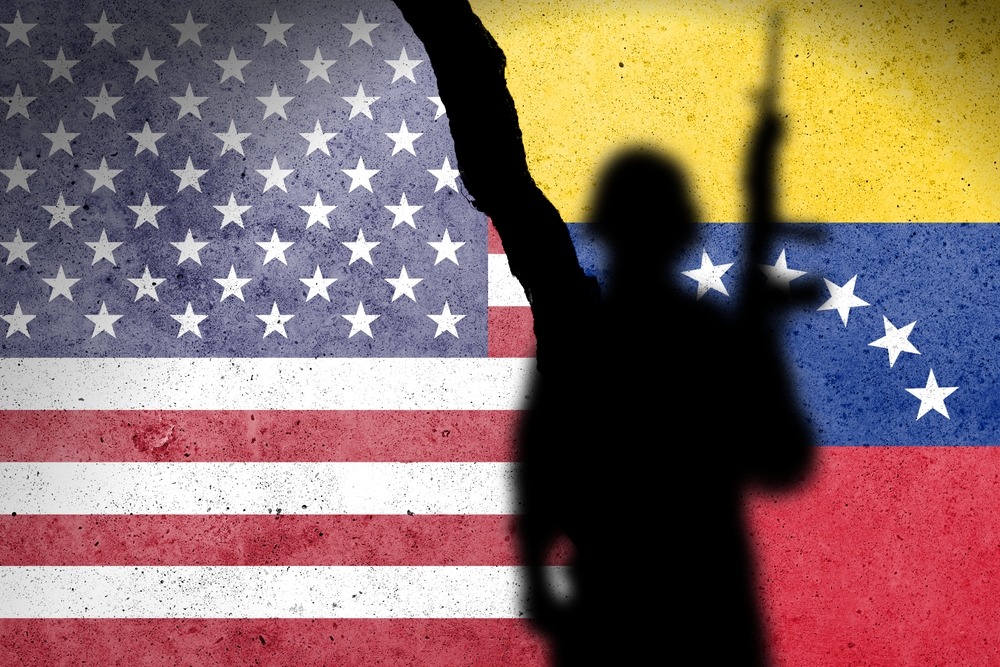
U.S. President Donald Trump’s pledge to oversee Venezuela following a controversial raid that resulted in the capture of President Nicolás Maduro has revived fears of another costly American foreign intervention, drawing comparisons to Iraq and Afghanistan and raising questions about Washington’s strategic and financial capacity.
Running Venezuela
The operation, carried out early Saturday, disrupted power supplies in parts of Caracas and targeted military facilities before U.S. Special Forces apprehended Maduro, 63, and his wife, Cilia Flores. The pair were airlifted to a U.S. Navy vessel off the Venezuelan coast and later flown to the United States, where Maduro now faces federal charges including narco-terrorism conspiracy.
“We will run the country until such time as we can do a safe, proper, and judicious transition,” Trump said during a press conference at his Mar-a-Lago estate in Florida.
The announcement marks a sharp escalation in Washington’s long-running campaign against Maduro, whom the Trump administration has accused of facilitating drug trafficking to the United States.
In recent months, U.S. officials intensified pressure on Caracas through an expanded military presence in the Caribbean and targeted actions against vessels suspected of narcotics transport. Maduro has repeatedly denied the accusations, arguing that U.S. actions are driven by a desire to exploit Venezuela’s vast oil reserves.
Venezuela holds the world’s largest proven oil reserves, but years of economic mismanagement, corruption, and international sanctions have severely weakened its energy sector.
Trump said major U.S. oil companies would re-enter the country to rehabilitate deteriorating infrastructure, a process analysts say could take years and require substantial investment. He also signaled openness to a sustained military presence.
“We’re not afraid of boots on the ground,” Trump said.
Cost of occupation
Trump framed the operation as a necessary step to curb drug trafficking and restore regional stability, but critics have questioned its feasibility and potential cost.
The president claimed the effort would be self-financing, asserting that any U.S. presence would be reimbursed through oil revenues. “It won’t cost us a penny,” Trump said, adding that funding would come from “the money coming out of the ground.”
Skeptics point to past U.S. interventions in Iraq and Afghanistan, where prolonged occupations cost trillions of dollars and resulted in thousands of military deaths despite early assurances that reconstruction would largely pay for itself.
Legal experts have also raised concerns about the operation’s legality under international law, particularly the detention of a sitting head of state. Democratic lawmakers in Congress said they were not fully briefed ahead of the raid and have called for a clear post-operation strategy.
Reaction in Venezuela
Inside Venezuela, the raid has fueled uncertainty. Vice President Delcy Rodríguez addressed the nation on state television alongside senior officials, condemning the action as an abduction.
“We demand the immediate release of President Nicolás Maduro and his wife, Cilia Flores,” Rodríguez said, declaring Maduro “the only president of Venezuela.”
The Venezuelan Supreme Court later designated Rodríguez as interim leader, according to state media.
International reactions
The move drew swift international condemnation. The United Nations Security Council is expected to meet Monday to discuss what Secretary-General António Guterres described as “a dangerous precedent.”
Russia and China, both key allies of Maduro, voiced strong opposition. China’s foreign ministry called on Washington to release Maduro and his wife immediately and pursue dialogue, warning that the operation violated international law and Venezuela’s sovereignty and threatened regional stability.
Trump dismissed the prospect of working with opposition figure María Corina Machado, a Nobel Peace Prize laureate widely viewed as Maduro’s strongest political rival. “She doesn’t have the support within or the respect within the country,” he said.
The episode has revived memories of past U.S.-backed regime-change efforts in Latin America and beyond, unsettling Western partners who, while critical of Maduro’s disputed 2024 election victory, favor diplomatic engagement over unilateral military action.
What to watch
As Maduro prepares to appear in federal court in Manhattan on Monday, uncertainty surrounds Washington’s authority inside Venezuela, where existing state institutions remain intact and cooperation with U.S. plans appears unlikely.
Trump’s vision of a “judicious transition” remains undefined, as concerns mount over the risk of a power vacuum, prolonged instability, and broader regional fallout.