The collapse of the NFT market forced OpenSea to lay off more than half of its workforce. Now, the once–NFT-focused startup is reinventing itself as a broad crypto trading platform, with renewed momentum driven largely by memecoin activity.
Even as Washington grows more receptive to cryptocurrency and token prices surge, once-hyped corners of the digital asset world—especially NFTs—remain depressed. Few companies felt the downturn more acutely than OpenSea, which built its business almost entirely around nonfungible tokens.
Beginning in mid-2022, the NFT market for digital collectibles such as CryptoPunks and Bored Apes collapsed by more than 80%. By October 2023, OpenSea’s monthly revenue had plunged to just $3 million, down from a peak of $125 million in January 2022. That same month, the company had been valued at $13.3 billion, briefly making its cofounders billionaires on paper.
The decline wasn’t solely due to fading interest in NFTs. OpenSea was also overtaken by a fast-rising competitor, Blur, which attracted traders by charging no transaction fees and eliminating mandatory creator royalties. When OpenSea loosened its own royalty policies to compete, it sparked backlash from users on social media, who accused the company of betraying creators and abandoning its principles.
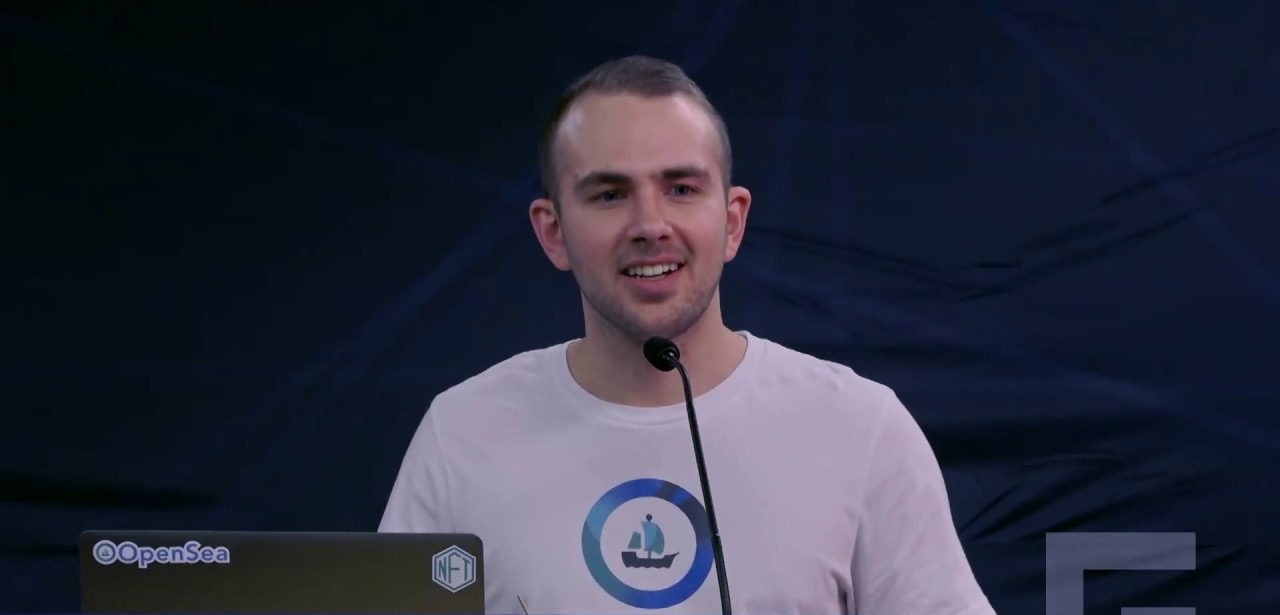
As revenue dried up and market share slipped away, cofounder and CEO Devin Finzer gathered OpenSea’s 175 employees at the time for an all-hands meeting in Los Angeles. He announced a major reset, telling staff the company would lay off more than half its workforce in order to survive as a leaner, more agile operation. Employees who remained were also offered voluntary severance packages.
Finzer has since said the decision was more painful than anticipated, as many highly regarded employees chose to leave. Today, OpenSea operates with roughly 60 employees and 10 contractors, most of them working remotely. Finzer frequently works from a shared office space in Manhattan, where only a handful of New York–based employees regularly come in.
After enduring a prolonged bear market for NFTs that may never fully recover, OpenSea has pivoted aggressively. Leveraging a user base that still draws millions of monthly visitors, the company has expanded beyond NFTs to become a platform for buying and selling all types of crypto tokens across 22 blockchains.
That transformation has allowed OpenSea to tap into the explosive growth of memecoins and broader crypto trading, helping drive a resurgence in volume and signaling a new chapter for a company once defined entirely by digital art.
Finzer, 34, credits his wife, Yu-Chi Lyra Kuo, with sparking the idea to transform OpenSea into a platform for trading all types of cryptocurrency. Kuo, an early crypto investor, pursued a PhD in philosophy and politics at Princeton, earned a law degree from Harvard, and left academia in 2016 to run a crypto trading fund. She met Finzer in 2021 and soon stepped away from fund management. “I really consider her a silent cofounder of OpenSea 2.0,” Finzer says. Though she holds no official role, her influence on the company’s direction has been substantial.
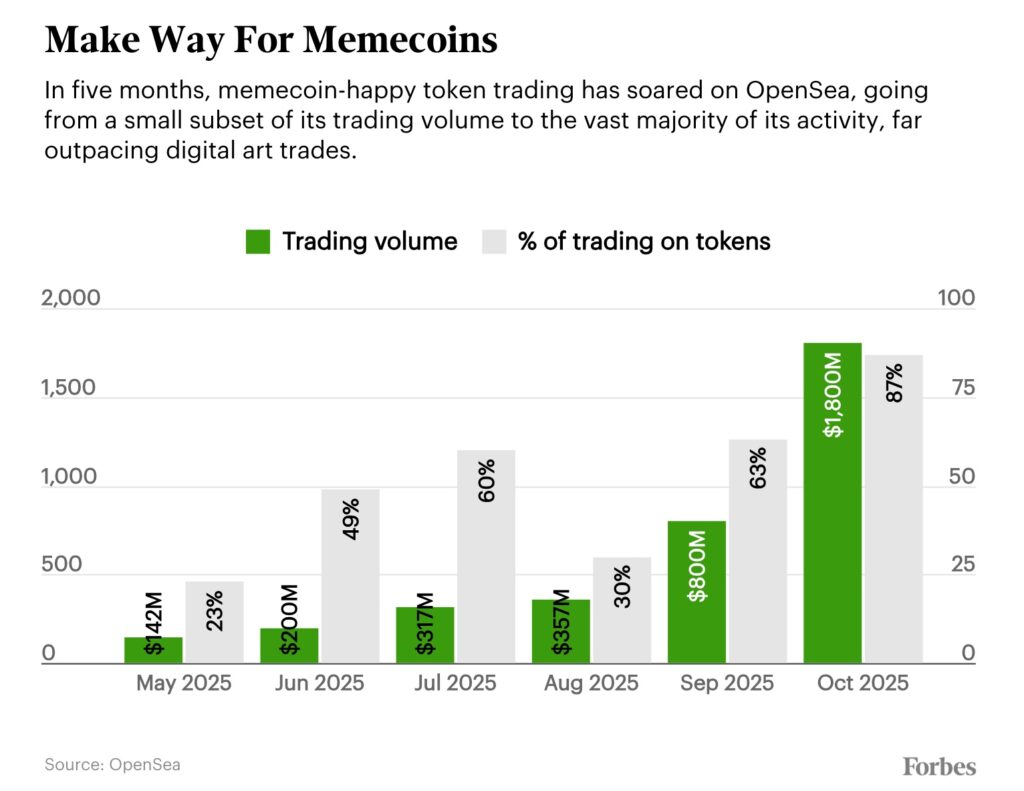
The strategy is already paying off. During the first two weeks of October 2025, OpenSea facilitated $1.6 billion in cryptocurrency trades and $230 million in NFT transactions, up sharply from just $142 million in total volume for all of May. The surge is on track to make October the company’s strongest month in more than three years. Under its new model, OpenSea aggregates buy and sell orders from decentralized exchanges such as Uniswap and Meteora, charging roughly 0.9% per transaction. That translated into about $16 million in revenue over a two-week period.
Finzer’s approach reflects a classic trading maxim: don’t fight the trend. As bitcoin prices soar, crypto adoption widens, and prediction markets gain traction, investor sentiment has turned decisively risk-on. The rally in Robinhood’s stock and the growth of platforms like Kalshi and Polymarket underscore that shift. Even as NFT collections such as the Bored Ape Yacht Club have seen their floor prices collapse from roughly $400,000 at their peak to about $32,000, speculation continues elsewhere in crypto. For the past two years, memecoins have dominated attention. “You can’t fight the macro trend,” Finzer says.
Finzer believes OpenSea’s move to support trading across all tokens aligns with current demand. In doing so, he has borrowed from the playbook of former rival Blur, which disrupted the NFT market with a trader-first strategy and quickly seized market share.
That rivalry also shaped Finzer’s leadership style. When Blur eliminated trading fees and creator royalties, Finzer responded with a series of shifting policy changes that attempted to balance competing interests. The result pleased no one. He now says the experience taught him to stop chasing consensus and trust his own judgment. “The only way you get better is by having the thing happen and failing your way through it,” he says.
In hindsight, Finzer and former chief technology officer Nadav Hollander argue that OpenSea’s mass layoffs were necessary. The cuts flattened the organization and removed layers of technical management, leaving a team where every engineer writes code. Finzer has also abandoned the Silicon Valley instinct to scale headcount aggressively, opting instead to keep the company as small and efficient as possible—a philosophy increasingly popular in the AI era.
Meanwhile, Blur has faded from prominence. Its trading volume has fallen to roughly $92 million over the past month, down from more than $1 billion in early 2023. The company’s public communications have largely gone silent. “In crypto, some people are there to get in and get out,” Finzer says.
Despite the crowded landscape of crypto trading apps, no platform has fully solved the challenge of making it easy to trade millions of tokens across multiple blockchains while allowing users to retain custody of their assets. Centralized exchanges like Coinbase offer hundreds of tokens, but that represents only a fraction of what exists—and they typically hold users’ assets on their behalf. While that model is familiar to traditional investors, it runs counter to the self-custody ethos that many crypto purists embrace.
Finzer says OpenSea’s ability to let users trade across 22 blockchains is one of its biggest advantages, though it comes with technical and security challenges. The company must continuously index new tokens, find optimal pricing, simplify the user experience, help users discover assets, and protect them from scams.
OpenSea previously succeeded by making NFTs accessible to everyday users, and Finzer hopes to replicate that success across all token trading. His goal is an interface as intuitive as mainstream apps like Coinbase or Robinhood, while quietly routing trades through decentralized venues favored by more sophisticated users.
To that end, OpenSea does not conduct traditional identity verification checks. Finzer says the company is not legally required to do so because it does not custody user assets and is not classified as a U.S. money transmitter. Instead, OpenSea relies on blockchain analytics to screen wallets for sanctioned addresses and suspicious activity. Still, that light-touch approach could expose the company to future regulatory risk, particularly under a less crypto-friendly administration.
OpenSea’s broadened focus also places it at the intersection of art, culture and high-risk financial speculation—a difficult balance to strike. Finzer insists he doesn’t want to build a purely transactional platform, yet the site’s token-trading experience increasingly resembles a speculative financial app.
He believes NFTs, memecoins and other digital assets can coexist within one ecosystem. OpenSea, he says, is still far from realizing its full vision and has yet to launch a redesigned mobile app. The company is also expected to release its own token, though details remain undisclosed.
While regulatory uncertainty looms, competition may pose an even greater challenge. With hundreds of crypto exchanges operating globally and low barriers to entry, OpenSea’s edge will depend on trust and execution. “There’s a lot of moat in consistently delivering a quality product,” Finzer says. The volatile history of crypto—and of OpenSea itself—suggests that advantage will be tested again.